
Quick answer: Running a new gas line to an appliance costs $350 to $2,000 for most homes, with the national average landing around $1,000. Plumbers price the work at roughly $15 to $25 per linear foot for a straightforward indoor run, and $35 to $50+ per foot when the line goes underground or through finished space. A short branch for a stove usually runs $400 to $1,500; a buried line to a standby generator can reach $3,500.
Those are national figures. Below is what actually sits behind them — the cost of each common project, the six things that move the price, what a permit and pressure test cover, and how we handle the work here in the Chicago area. Every fall we see the same four requests in the same order: a furnace that will not light, a generator before the first ice storm, a gas range before Thanksgiving, and a fire pit or patio heater to stretch the season. If one of those is on your list, this is the number to plan around.

Gas line installation cost by project (2026)
The appliance itself matters less than how far the gas has to travel and what is in the way. These ranges reflect materials, labor, fittings and a pressure test on a typical home with an existing gas meter.
| Project | Typical installed cost | What drives it |
|---|---|---|
| Gas stove or range | $400 – $1,500 | Distance from the nearest existing line; opening finished walls or cabinets |
| Clothes dryer | $300 – $1,000 | Usually a short branch off the laundry-room or basement line |
| Water heater or furnace hookup | $300 – $1,000 | Often just a new drop, valve and connector; more if the trunk line is undersized |
| Outdoor grill or patio kitchen | $500 – $1,800 | Exterior wall penetration; buried run under a deck or lawn adds trenching |
| Fire pit or patio heater | $600 – $2,000 | Almost always underground; needs a shut-off and a key valve at the pit |
| Standby generator | $1,000 – $3,500 | Larger-diameter pipe, long buried run, and sometimes a meter or regulator upgrade |
| New service from the street to the house | $2,000 – $10,000+ | Set by the gas utility; length from the main, road or sidewalk cuts |
Two things surprise homeowners in that table. First, a stove line can cost as much as a generator line if the kitchen is on the far side of the house from the meter and every wall between them is finished. Second, the generator number is often only the pipe: the generator, its concrete pad and the electrical transfer switch are separate trades and separate bills.
What actually moves the price
When two neighbors with the same grill get quotes $900 apart, one of these six factors is the reason.
1. Distance from the nearest gas line
Per-foot pricing is where the estimate starts. A range that sits ten feet from the basement trunk line is a small job. The same range forty feet away, on a slab, with no basement to run through, is not. Before you get a quote, find your meter and trace where the existing lines run — the closer you can put the new appliance to them, the less you pay.
2. Indoor versus underground
An exposed run through an unfinished basement ceiling is the cheapest gas line there is. Once the pipe has to go outside, the cost roughly doubles: trenching runs $5 to $15 per foot on its own, the pipe must be buried at the depth your municipality requires, and the yard, patio or driveway on top of it has to be put back. Directional boring under a driveway instead of cutting it costs more still.
3. Pipe material
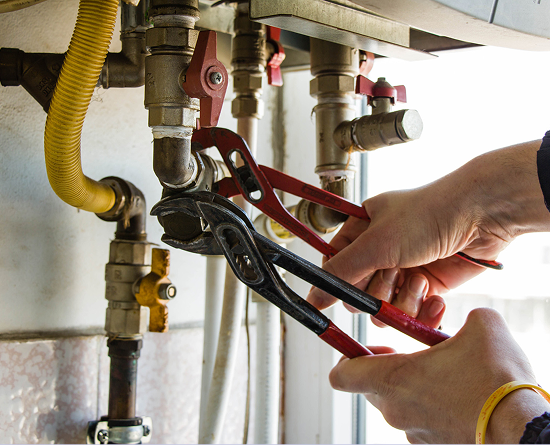
Three materials show up in residential work. Black iron (threaded steel) is the traditional indoor choice: durable, inexpensive per foot, but labor-heavy because every joint is cut, threaded and doped by hand. CSST (corrugated stainless steel tubing, the yellow or black flexible line) installs faster and snakes around obstacles, but the fittings cost more and it must be properly bonded to the electrical system. Polyethylene (black plastic pipe) is for buried runs only and needs special transition fittings where it comes above ground. Some municipalities restrict where CSST can be used, so the material is often chosen for you by local code rather than by preference.
4. Pipe sizing and your meter’s capacity
This is the factor nobody budgets for. Every gas appliance has a BTU rating, and the pipe feeding it has to be sized for the total load on that branch. A 20 kW standby generator can pull as much gas as the furnace, water heater and range combined. If the existing trunk line or meter cannot carry the added load, the job grows to include a larger meter (through the utility) or a new dedicated line from the meter — and a quote that started at $1,200 becomes $3,000. A good estimate includes a load calculation up front, so this is not discovered after the trench is dug.
5. Permits, pressure test and inspection
Nearly every town in the Chicago area requires a permit for new gas piping, and the inspector will want to see a pressure test before the line is connected. Budget $100 to $300 for the permit and $75 to $150 for the test if it is quoted separately. Most licensed plumbers roll both into the price; if a quote does not mention either, ask why.
6. Access and what has to be put back
Finished basements, plaster walls, tile backsplashes and stamped concrete patios do not change the plumbing — they change what it costs to get to it and what it costs to repair afterward. Patching drywall is usually included. Re-tiling, repainting or re-sodding usually is not, so ask what the quote covers.
Why fall is gas line season
Gas line calls come in waves, and the biggest wave starts in October. Four reasons:
- First furnace start-up. The furnace runs for the first time in six months and struggles to ignite, cycles on and off, or trips a fault. Sometimes it is the furnace. Often it is low gas pressure from a corroded or undersized line, a stuck valve, or a fitting that loosened over the summer.
- Standby generators. Ice storms and heavy wet snow bring down lines across northern Illinois every winter. Homeowners who lost power last year order generators in September and need the gas line before the unit is delivered.
- Kitchen upgrades before the holidays. Swapping an electric range for gas is the most common indoor gas line job we do, and the deadline is almost always Thanksgiving.
- Outdoor living. Fire pits, patio heaters and outdoor kitchens are best plumbed while the ground is still soft. Once the frost line sets in, trenching gets slower and more expensive, and some municipalities stop issuing underground permits until spring.
Practical advice: if the project involves digging, book it before mid-November. Indoor work can be done year-round.
What a professional gas line installation includes
A quote for “running a gas line” should cover all of the following. If it does not, you are comparing a different job.
- Load calculation and pipe sizing for every appliance on the branch, not just the new one.
- Permit pulled with your municipality, in the plumber’s name and license.
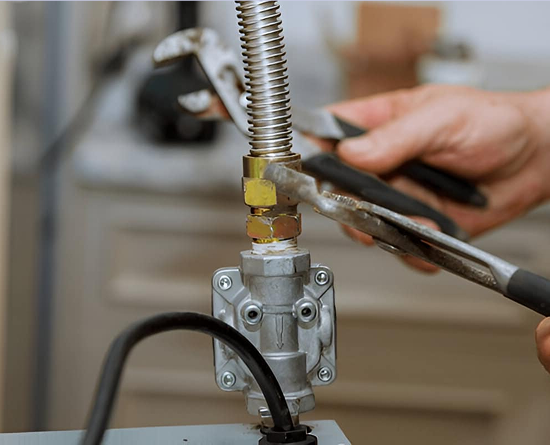
- Routing and installation with a dedicated shut-off valve at the appliance and a drip leg (sediment trap) where code requires it.
- Pressure test — the line is capped, pressurized with air and held on a gauge, typically for 15 to 30 minutes, to prove it holds before gas is ever introduced.
- Municipal inspection of the test and the piping.
- Appliance connection with an approved flexible connector, then a leak check at every joint with gas on.
- Bonding for CSST, and restoration of any drywall opened along the way.
Gas piping is not a do-it-yourself job, and not only because it is dangerous. In Illinois the work must be done by a licensed plumber, and an unpermitted line can void a homeowner’s insurance claim if anything goes wrong later. The savings are not worth it.
Gas line repair cost versus replacement
Not every gas line call is a new line. Repairs — a leaking union, a corroded fitting, a damaged section behind a wall — typically run $150 to $800, with leak detection using an electronic sniffer or a pressure test adding $100 to $300 if the source is not obvious. Full replacement of an old steel line makes more sense than repair when the pipe shows widespread rust, when it fails a pressure test in more than one place, or when the house is being repiped for a larger load anyway.
The four warning signs we tell homeowners to watch for, all of which are covered in more detail on our gas line repair and installation page:
- A gas appliance that no longer works the way it should — weak burner flames, yellow instead of blue, or an oven that takes forever to heat.
- A gas odor near an appliance.
- A furnace that struggles to ignite when it turns on.
- A hissing sound from a gas appliance or a section of pipe.
Smell gas? Do this first
Natural gas has no smell; utilities add mercaptan so it smells like rotten eggs or sulfur. If you notice it indoors: do not flip any switch, light or appliance on or off; open a door on your way out; leave the house; and call your gas utility’s emergency line or 911 from outside. In the Chicago area that is Nicor Gas or Peoples Gas, depending on where you live. Once the utility has shut the gas off and confirmed the house is safe, that is when a plumber comes in to find and fix the leak and get the pressure test the utility will require before service is restored.
How Iron Wrench Plumbing handles gas line work
We are a family-owned shop working out of 1280 Townline Rd. in Mundelein, and gas piping is one of our core services alongside water heaters, sump pumps and emergency plumbing. Our licensed, insured plumbers install new gas lines for furnaces, ranges, water heaters, dryers, generators and outdoor appliances; repair leaks and damaged sections; replace old, corroded lines with new ones sized for the load; and inspect existing systems for homeowners who want peace of mind before heating season.
Every gas job follows the same four steps:
- Request and scheduling. Call (847) 238-8683 or book online. For a suspected leak we come out around the clock; for a planned installation we schedule at a time that works for you.
- On-site evaluation and estimate. A plumber measures the run, checks the meter and existing piping, does the load calculation and gives you a clear, itemized price before any work starts — no hidden fees, no surprise charges once the wall is open.
- Quality service by professionals. Permit, installation, pressure test, inspection and appliance hookup, done by the same licensed crew from start to finish.
- Satisfaction guarantee. Every job carries our quality guarantee, and we do not consider it finished until the appliance is running and you have seen the test.
One of our customers, Samantha H., put it this way in her Google review: “From the service call and quote to the install — 5 star service. Everyone was very nice and helpful.” That is the standard on every gas line we run.
We do not publish a flat rate for gas lines because, as the table above shows, the same appliance can be a $500 job or a $2,500 job depending on the house. What we commit to is that the number you get on-site is the number you pay. We serve Mundelein, Libertyville, Vernon Hills, Lake Zurich, Gurnee, Buffalo Grove, Arlington Heights, Schaumburg, Evanston and the rest of Lake County and the north and northwest Chicago suburbs.
Five ways to keep the cost down
- Put the appliance near the existing line. Moving a grill ten feet closer to the house can save a few hundred dollars of trenching.
- Bundle projects. Running lines for a range and a dryer in one visit costs far less than two separate jobs, because the permit, test and inspection are shared.
- Trench once. If you are already digging for a patio, irrigation or electrical conduit, run the gas line in the same trench.
- Book before the rush. September and early October quotes are easier to schedule than mid-November ones, and outdoor work is cheaper before the ground freezes.
- Ask about meter capacity before you buy the generator. Knowing whether your meter can carry the load changes which unit you order and what the pipe will cost.
Frequently asked questions about gas line installation
How much does it cost to run a gas line for a stove?
A gas line for a stove or range typically costs $400 to $1,500 installed. The low end is a kitchen close to an existing gas line with an accessible basement below; the high end involves a long run through finished walls or a slab foundation. The cost includes the pipe, a shut-off valve, a pressure test and, in most areas, a permit.
How much does a gas line for a generator cost?
Expect $1,000 to $3,500 for the gas line alone. Standby generators need larger-diameter pipe than most appliances and are usually placed outdoors, so the run is buried. If the existing meter cannot supply the added load, a meter upgrade through the gas utility adds to the cost. The generator, pad and electrical transfer switch are priced separately.
Can I install a gas line myself?
No. In Illinois, gas piping must be installed by a licensed plumber, and virtually every municipality requires a permit and inspection. Beyond the legal issue, an unpermitted gas line can void a homeowner’s insurance claim if a leak causes damage.
How long does it take to install a gas line?
Most single-appliance installations take two to six hours on site. Underground runs to a generator or fire pit can take a full day once trenching is included, and the municipal inspection may add a day or two before the appliance can be connected.
Does a gas line need a pressure test?
Yes. Before gas is introduced, the new piping is sealed, pressurized with air and monitored on a gauge to confirm it holds without dropping. Inspectors require it, and it is the only way to prove every joint is sound. A pressure test usually costs $75 to $150 when quoted separately, and most plumbers include it in the installation price.
Is black iron pipe or CSST better for a gas line?
Both are safe when installed correctly. Black iron is rigid, inexpensive per foot and the traditional indoor choice, but every joint is threaded by hand, so labor is higher. CSST is flexible, installs faster and works well around obstacles, but its fittings cost more and it must be bonded to the home’s electrical grounding system. Local code sometimes decides for you; your plumber should explain which one your municipality allows and why they recommend it.